
You've got a wedding, a reunion, or a beach trip coming up. You want a tan. Now the question sitting in your browser tabs is whether you grab a bottle of self-tanner from the drugstore or book a professional session. It sounds simple, but the gap between those two choices is bigger than most people expect, especially when you're getting ready for something that actually matters. Getting it wrong means showing up streaky, orange-toned, or with a weird patchy elbow situation nobody wants to explain. If you're planning something with a group, a Group Spray Tanning Salon in Wildwood FL can handle everyone at once with consistent, matched results. But let's back up and break this down honestly so you can decide what actually makes sense for your situation.
How the Products Actually Differ
Most at-home self-tanners use dihydroxyacetone, or DHA, as the active ingredient. It reacts with the amino acids in your skin's outer layer to produce a brown color. That part is the same whether you're using a drugstore mousse or a professional solution. The difference is in the formulation. Professional spray tanning solutions are mixed at specific DHA concentrations matched to your skin tone, and they often include bronzers, pH adjusters, and skin-prep ingredients that help the color develop more evenly and last longer.
At-home products are one-size-fits-all. Sort of. They're formulated to be safe for anyone to apply, which means they're often conservative in concentration and don't account for the fact that fair skin, olive skin, and deeper skin tones all oxidize differently. You might get a result that's too warm, too ashy, or just flat. Not great when you wanted a sun-kissed glow.
Professional solutions can also be layered. A technician can build depth in certain areas and keep things lighter in others, mimicking how a natural tan actually falls on the body. You can't really do that with a bottle and a mitt at home.
The Real Risks of Doing It Yourself
Streaking is the obvious one. But honestly, missed spots are worse. The backs of knees, the inner arms, between fingers, the hairline. These are spots you can't easily see while applying, and they're exactly where uneven color shows up first. Most people don't notice until they're dressed and standing in bright light somewhere they can't fix it.
Oxidation timing is another issue that catches people off guard. DHA takes anywhere from four to eight hours to fully develop, and what you see right after applying is often just a guide bronzer, not the final color. A lot of people look at it an hour in, think it's too light, and either add more or rinse it off too early. Both are mistakes. The final result is rarely what you expected when you started.
Undertone mismatches are also really common. If your skin runs cool and you use a product with warm undertones, you'll end up looking orange rather than bronzed. Matching undertones to skin type is something most product labels barely mention, but it makes a noticeable difference. According to the Wikipedia overview of dihydroxyacetone, DHA's reaction with skin proteins varies based on skin composition, which is part of why results differ so much between people using the same product.
What a Trained Technician Actually Controls
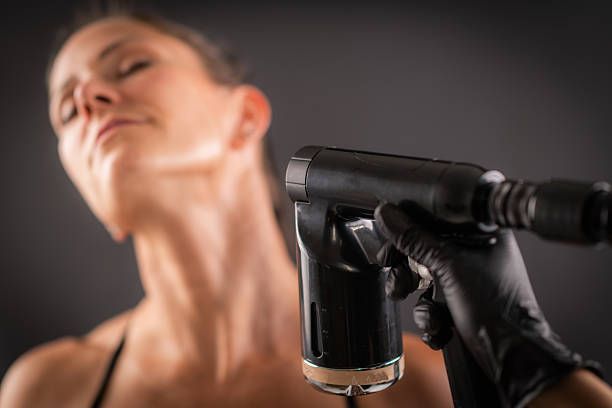
This is where the comparison gets real. A professional spray tan technician isn't just pointing a gun at you and hoping for the best. They're controlling spray distance, solution concentration, application speed, and layering. Each of those variables changes the final result. Too close and you get pooling. Too far and you lose evenness. It's more technical than it looks.
They're also prepping your skin correctly beforehand and reading how your skin is responding in real time. If your skin is dry in certain areas, they adjust. If you've got a deeper natural tone, they mix accordingly. That kind of real-time calibration just doesn't happen when you're doing it yourself in your bathroom with your arm stretched behind your back.
For groups, this matters even more. Sunslingers is a good example of a salon set up specifically to handle multiple people efficiently, matching solutions across different skin tones so everyone in the group looks cohesive rather than like they each used a different product. That's genuinely hard to pull off at home, even if everyone is experienced with self-tanning.
Breaking Down the Cost Honestly
People assume DIY is always cheaper. Sometimes it is. But let's add it up. A quality self-tanning mousse runs around $30 to $45. A good tanning mitt is another $10 to $15. A proper exfoliating scrub before application, another $12 to $20. Barrier cream for ankles, knees, and elbows, a few more dollars. You're already at $55 to $80 before you've applied anything, and that's assuming you buy decent products instead of the cheapest options.
A professional session, depending on location, typically runs $40 to $80 for a single person. For groups, per-person rates often drop. So you're sometimes paying less per session at a salon than you'd spend assembling your DIY kit, and you're getting a result that doesn't require two hours of prep and post-care ritual. For regular maintenance, DIY makes sense. For a one-time event where you need it right, professional wins on value pretty consistently.
When Each Option Actually Makes Sense
DIY self-tanning is genuinely fine for a lot of situations. Casual maintenance between events, a low-stakes weekend, or just keeping some color going through the winter. If you've practiced, know your product, and have a routine that works for you, it's a solid option. Not everything requires a salon.
But for high-stakes events, especially ones involving photos, formal wear, or multiple people who need to look consistent together, professional is the safer bet. Group Spray Tanning in Wildwood FL gets popular around wedding season and reunion time for exactly this reason. Bridesmaids who all self-tanned with different products in different bathrooms the night before look noticeably mismatched in photos. That's a real thing that happens. A lot.
If you're on the fence, think about the stakes. Low stakes, everyday color? DIY works. High stakes, one chance to get it right, multiple people involved? That's what Group Spray Tanning in Wildwood FL is actually built for. A Group Spray Tanning Salon in Wildwood FL handles the logistics, the matching, and the technique so you're not troubleshooting orange knees at 7am the morning of the event.
Frequently Asked Questions
How long does a professional spray tan last compared to DIY?
Most professional spray tans last seven to ten days with proper aftercare. At-home self-tanners usually fade faster, around five to seven days, partly because the DHA concentration is lower and the application is less even. Moisturizing daily and avoiding long soaks in the tub helps both last longer.
Can I get a spray tan the day before an event?
Yes, and that's actually the recommended timing. Getting it done 24 hours before gives the color time to fully develop and lets you shower off any excess bronzer so the final result is what you're actually wearing to the event. Don't wait until the morning of. That's rushing it.
Is spray tanning safe for sensitive skin?
For most people, yes. DHA is FDA-approved for external skin use. But if you have very reactive skin or certain skin conditions, it's worth doing a patch test first or talking to a dermatologist. Most professional salons can also adjust the solution to avoid common irritants if you let them know ahead of time.
Do I need to do anything before my appointment?
Exfoliate the day before, shave at least 24 hours ahead, and skip heavy moisturizers or oils on the day of. Show up with clean, dry skin and no deodorant. These steps matter more than most people realize. Skipping them is one of the main reasons spray tans don't last as long as they should.
How does group spray tanning work logistically?
Most salons that do group bookings set up back-to-back appointments in a single session block, or they have multiple technicians working at the same time. You'll usually all get matched solutions so the results look consistent across different skin tones. It's worth calling ahead to ask about group rates and how the salon handles matching, since not every place does it the same way.